- 您現在的位置:買賣IC網 > PDF目錄371031 > MC34059 (Motorola, Inc.) 5-V Battery-Backup Supervisors for RAM Retention 8-MSOP -40 to 85 PDF資料下載
參數資料
| 型號: | MC34059 |
| 廠商: | Motorola, Inc. |
| 英文描述: | 5-V Battery-Backup Supervisors for RAM Retention 8-MSOP -40 to 85 |
| 中文描述: | 六角環評- 485收發器與三態輸出 |
| 文件頁數: | 11/12頁 |
| 文件大小: | 237K |
| 代理商: | MC34059 |
MC34058 MC34059
11
MOTOROLA ANALOG IC DEVICE DATA
θ
jc for the package on this board is 25
±
20% depending on the location of
the package on the board.
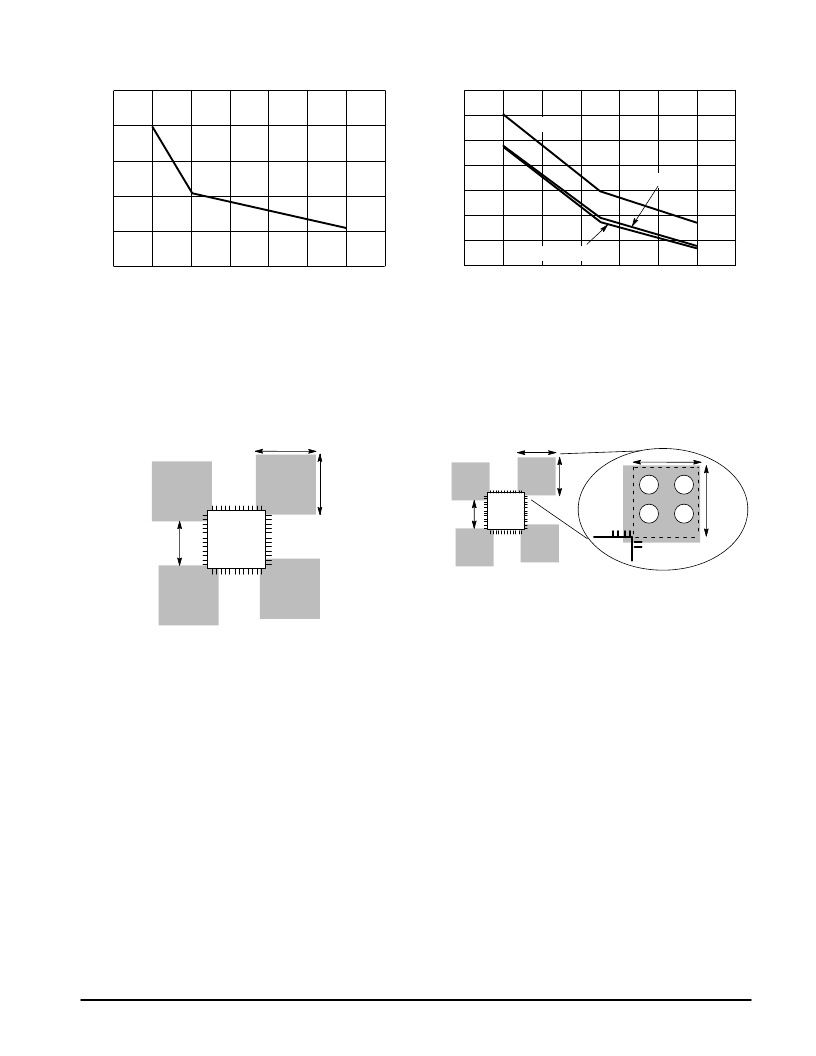
Figure 13. Thermal Resistance (
θ
ja) for Board
with Large External Ground Plane
55
θ
j
AIR SPEED (LINEAR FT/MIN)
0
100
200
300
500
50
45
40
35
30
°
400
600
θ
j
°
* Masked radiators were covered by a solder mask. Exposed radiators
were bare copper.
Figure 14A. Thermal Resistance (
θ
ja) for
Board Without Ground Plane
120
AIR SPEED (LINEAR FT/MIN)
0
200
400
600
1000
100
80
60
50
110
90
70
800
1200
Exposed Radiators*
Masked Radiators*
No Radiators
Figure 14B. Layout Used for Thermal Resistance
Measurements in Figure 14A
8 (mm)
8 (mm)
Copper
Radiators
l (mm)
w (mm)
Copper
Radiators
l (mm)
w (mm)
Figure 15. Placement of Thermal Vias to Enhance
Heat Transfer to Ground Plane
Figure 14A on the other hand shows the result of a single
layer board without an internal ground plane. The graphs
show that even though there are radiators of substantial area
surrounding the package, substantial degredation of thermal
performance is evident (Figure 14B shows the layout used
for the measurements in Figure 14A). Comparing Figures 13
and 14A shows almost a 2:1 improvement for the strategy
involving the external ground plane.
It is clear from Figures 13, 14A and Example 1, that if an
application is to use all the device drivers, preparations to
assure adequate thermal performance of the system must
be taken.
If an extensive external ground plane is unavailable, and
only an internal ground plane is available, the thermal
performance of the device can still be improved by providing
thermal vias to connect the radiators to the internal ground
plane. Figure 15 shows a proposed scheme for thermal vias
(contact board manufactures for specifics about the thermal
performance of their products and possible enhancements).
The thermal resistance for this structure on 1.0 oz. Copper
connecting each of the four radiators to an internal ground
plane and provide an estimated thermal resistance of
approximately 5.0
°
C/W. The vias used in the estimate had
80 mil diameters, on 100 mil centers and a 1.0 mil copper
thickness.
相關PDF資料 |
PDF描述 |
|---|---|
| MC34059FTA | HEX EIA-485 TRANSCEIVER with THREE-STATE OUTPUTS |
| MC3405P | Processor Supervisory Circuits with Power-Fail 8-SOIC -40 to 85 |
| MC3405P | Processor Supervisory Circuits with Power-Fail 8-SOIC -40 to 85 |
| MC34065P-L | HIGH PERFORMANCE DUAL CHANNEL CURRENT MODE CONTROLLERS |
| MC34065DW-L | HIGH PERFORMANCE DUAL CHANNEL CURRENT MODE CONTROLLERS |
相關代理商/技術參數 |
參數描述 |
|---|---|
| MC34059FTA | 制造商:MOTOROLA 制造商全稱:Motorola, Inc 功能描述:HEX EIA-485 TRANSCEIVER with THREE-STATE OUTPUTS |
| MC3405P | 制造商:MOTOROLA 制造商全稱:Motorola, Inc 功能描述:DUAL OPERATIONAL AMPLIFIER / DUAL VOLTAGE COMPARATOR |
| MC3406 | 制造商:SHENZHENFREESCALE 制造商全稱:ShenZhen FreesCale Electronics. Co., Ltd 功能描述:N-Channel 30-V (D-S) MOSFET High performance trench technology |
| MC34060 | 制造商:未知廠家 制造商全稱:未知廠家 功能描述:精密開關模式脈寬調制控制電路 |
| MC34060A | 制造商:MOTOROLA 制造商全稱:Motorola, Inc 功能描述:PRECISION SWITCHMODE PULSE WIDTH MODULATOR CONTROL CIRCUIT |
發布緊急采購,3分鐘左右您將得到回復。