- 您現(xiàn)在的位置:買(mǎi)賣IC網(wǎng) > PDF目錄98220 > THS3091DDA (TEXAS INSTRUMENTS INC) 1 CHANNEL, VIDEO AMPLIFIER, PDSO8 PDF資料下載
參數(shù)資料
| 型號(hào): | THS3091DDA |
| 廠商: | TEXAS INSTRUMENTS INC |
| 元件分類: | 音頻/視頻放大 |
| 英文描述: | 1 CHANNEL, VIDEO AMPLIFIER, PDSO8 |
| 封裝: | GREEN, PLASTIC, SOP-8 |
| 文件頁(yè)數(shù): | 11/37頁(yè) |
| 文件大小: | 1078K |
| 代理商: | THS3091DDA |
第1頁(yè)第2頁(yè)第3頁(yè)第4頁(yè)第5頁(yè)第6頁(yè)第7頁(yè)第8頁(yè)第9頁(yè)第10頁(yè)當(dāng)前第11頁(yè)第12頁(yè)第13頁(yè)第14頁(yè)第15頁(yè)第16頁(yè)第17頁(yè)第18頁(yè)第19頁(yè)第20頁(yè)第21頁(yè)第22頁(yè)第23頁(yè)第24頁(yè)第25頁(yè)第26頁(yè)第27頁(yè)第28頁(yè)第29頁(yè)第30頁(yè)第31頁(yè)第32頁(yè)第33頁(yè)第34頁(yè)第35頁(yè)第36頁(yè)第37頁(yè)
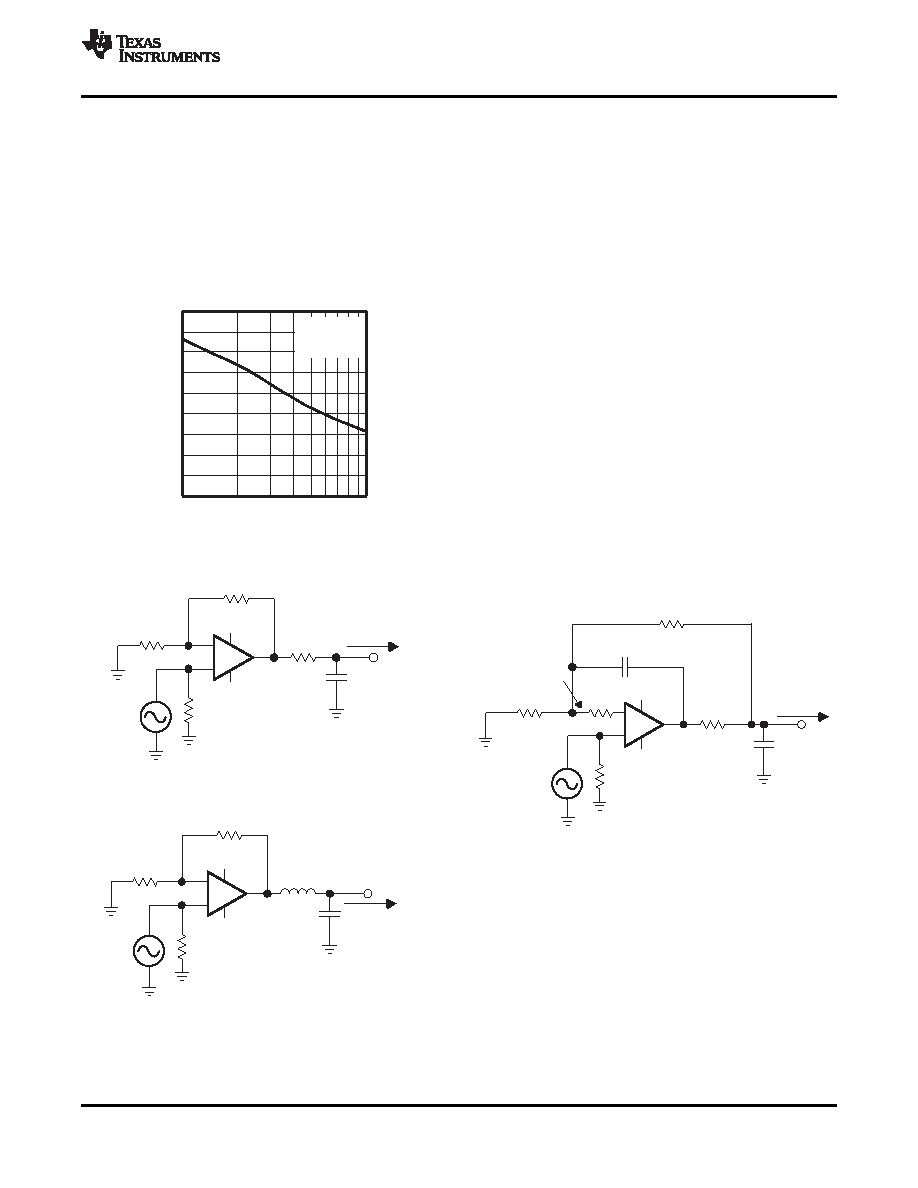
Driving Capacitive Loads
0
5
10
15
20
25
30
35
40
45
10
100
CL Capacitive Load pF
Recommended
R
ISO
Gain = 5,
RL = 100 ,
VS = ±15 V
_
+
VS
49.9
1 k
5.11
1
F
249
VS
100-
LOAD
RISO
_
+
VS
49.9
5.11
1
F
249
VS
27 pF
1 k
RF
RG
1 k
100-
LOAD
RIN
_
+
VS
49.9
1 k
Ferrite Bead
1
F
249
VS
100-
LOAD
www.ti.com........................................................................................................................................ SLOS423G – SEPTEMBER 2003 – REVISED OCTOBER 2008
Placing a small series resistor, RISO, between the
amplifier’s output and the capacitive load, as shown
Applications such as FET line drivers can be highly
in Figure 64, is an easy way of isolating the load
capacitive
and
cause
stability
problems
for
capacitance.
high-speed amplifiers.
Using a ferrite chip in place of RISO, as shown in
Figure 65, is another approach of isolating the output
methods for driving capacitive loads. The basic idea
of the amplifier. The ferrite's impedance characteristic
is to use a resistor or ferrite chip to isolate the phase
versus
frequency
is
useful
to
maintain
the
shift at high frequency caused by the capacitive load
low-frequency load independence of the amplifier
from the amplifier’s feedback path. See Figure 63 for
while isolating the phase shift caused by the
recommended resistor values versus capacitive load.
capacitance at high frequency. Use a ferrite with
similar impedance to RISO, 20 to 50 , at 100 MHz
and low impedance at dc.
Figure 66 shows another method used to maintain
the low-frequency load independence of the amplifier
while isolating the phase shift caused by the
capacitance at high frequency. At low frequency,
feedback is mainly from the load side of RISO. At high
frequency, the feedback is mainly via the 27-pF
capacitor. The resistor RIN in series with the negative
input is used to stabilize the amplifier and should be
equal to the recommended value of RF at unity gain.
Replacing RIN with a ferrite of similar impedance at
about 100 MHz as shown in Figure 67 gives similar
results with reduced dc offset and low-frequency
Figure 63. Recommended RISO vs Capacitive Load
noise.
(See
the
ADDITIONAL
REFERENCE
MATERIAL section for expanding the usability of
current-feedback amplifiers.)
Figure 64.
Figure 66.
Figure 65.
Copyright 2003–2008, Texas Instruments Incorporated
19
發(fā)布緊急采購(gòu),3分鐘左右您將得到回復(fù)。